Today, wealth is increasingly concentrated, while traditional redistributive mechanisms show structural limitations. A systematic approach aimed at concrete needs is needed. In today's world, an unprecedented concentration of wealth and income is taking place in the hands of a small minority of people. It was said that no one should have what is superfluous until everyone has what is necessary.
It is estimated that the richest 10% of the world's inhabitants own around 76% of the world's wealth, while the poorest half owns approximately 2%. Just over three thousand billionaires today have a combined wealth greater than the combined gross domestic products of most nations. Indeed, the twelve richest people in the world hold more wealth than the poorest half of the world's population; we will soon see the first individual in history with a personal fortune of over a trillion dollars.
Taxation should be the way to redistribute wealth from the few who own most of it to the many who need basic services. Unfortunately, taxes don't work properly. Laws offer wealthy individuals numerous ways to reduce progressive taxation, while governments must collect from the lower classes through regressive taxes on value added, fuel, public services, and so on. In any case, the enormous national debts around the world allow only a small portion of taxation to be successfully converted into genuine redistribution.
Philanthropy is a crucial factor, but it is not enough; a systemic solution is needed for a real and effective redistribution strategy. Furthermore, redistribution policies based on the direct provision of liquidity to beneficiaries have often proven inefficient, as many recipients have used the resources received inappropriately rather than for truly important needs.
In a world of growing inequality and widespread information circulation, the reputational gain resulting from one's willingness to support the redistribution of wealth is becoming increasingly relevant.
In order for our idea of redistribution to proceed towards a realistic goal, it is necessary to consider some key points:
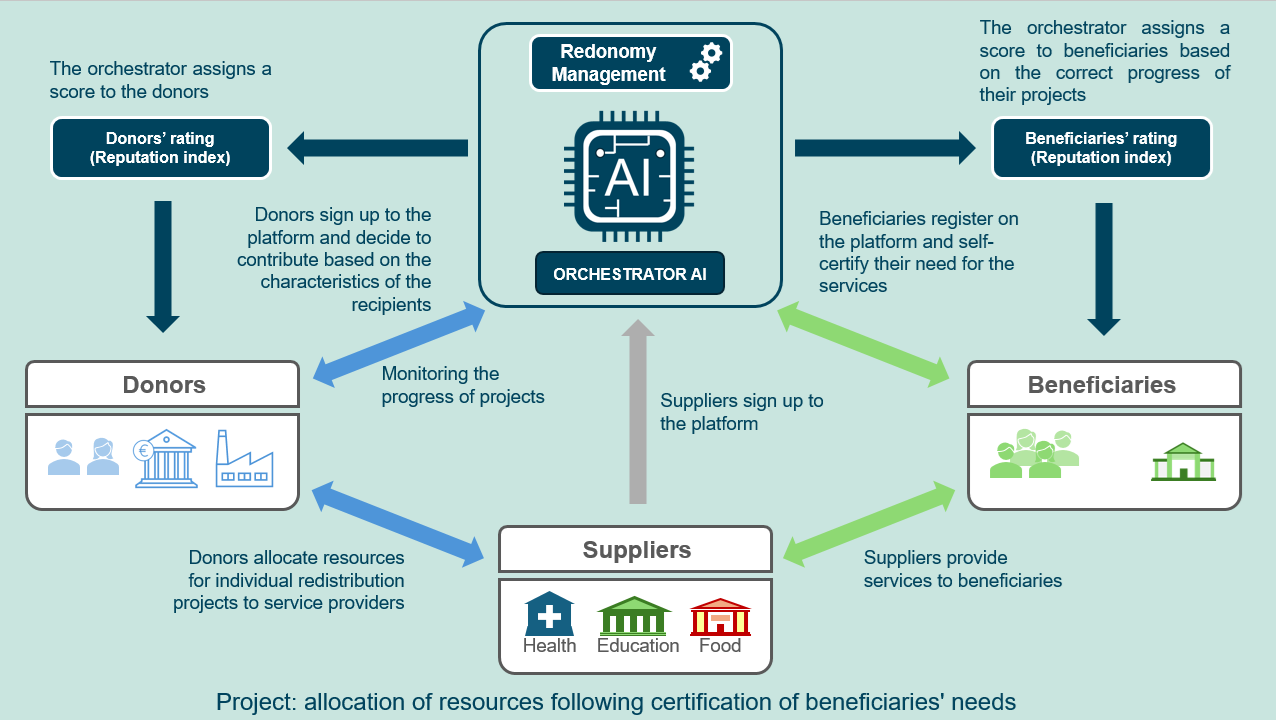
Redonomy's solution engages donors, beneficiaries, and service providers through a platform coordinated by an orchestrator developed with the potential of Artificial Intelligence.
Redonomy isn't a charity, but rather a business initiative aimed at promoting redistribution.
Redonomy involves three groups of stakeholders in the redistribution process. The first group consists of potential donors, who can be businesses or individuals. The second group includes prospective beneficiaries, who can be individuals or communities seeking support for various levels of education, healthcare, and food needs. The third group consists of providers of these services, such as daycare centers, preschools, universities, clinics, dentists, hospitals, and large-scale retail trade.
Redonomy will be centered around an orchestrator that uses Artificial Intelligence to examine potential areas of intervention and support initiatives. The orchestrator will identify the interventions with the most significant benefits for individuals or communities and propose them to potential donors.
Redonomy does not provide direct payments to individual beneficiaries, to ensure their proper use. Donated funds are not expected to transit through the Redonomy platform.
The system will assess the reliability of beneficiaries and the commitment of donors through scores automatically assigned by the orchestrator. These scores will ensure that personal data is used in accordance with current legislation.
Each redistribution project will be certified on blockchain, ensuring an objectively unmodifiable record. For long-term projects, progress can be identified and funds released upon reaching specific objectives, such as academic goals. The use of smart contracts will confirm to donors that a goal has been reached and support them in making the next contribution.
The Redonomy orchestrator will assign final beneficiaries a score defined by a proprietary algorithm and dependent on the objectives achieved. This score will serve to characterize the beneficiaries' reliability and facilitate their access to additional benefits. The operational hypothesis is that the data on the objectives will be provided to the orchestrator by the beneficiaries in the form of self-certification. However, the system will be organized to perform random checks.
Similarly, the orchestrator will assign donors a score based on various parameters such as the size of the projects supported and their impact on society.
Redonomy envisions the involvement of public institutions, which could officially assign value to the scores awarded to initiative participants. The state could compensate the donor by granting tax breaks commensurate with the score earned. In the case of a business, other benefits could also be provided, for example in calculating rankings in public procurement tenders.
Goal: Support the growth of a new type of economy aimed at bridging the gap between the many with fewer resources and the few more affluent, one that effectively helps beneficiaries and rewards donors.
How: Define a transparent paradigm for the intelligent management of a redistribution process.
Mauro is an engineer with a long-term expertise in ICT, crypto/cyber ecosystems and worldwide business opportunities.